Billings and Montana guidance
How to Choose a Qualified Radon Mitigation Provider
Verify the individual, credential type, current status, provider identity, insurance, and project scope instead of relying on a badge or broad “certified” claim.
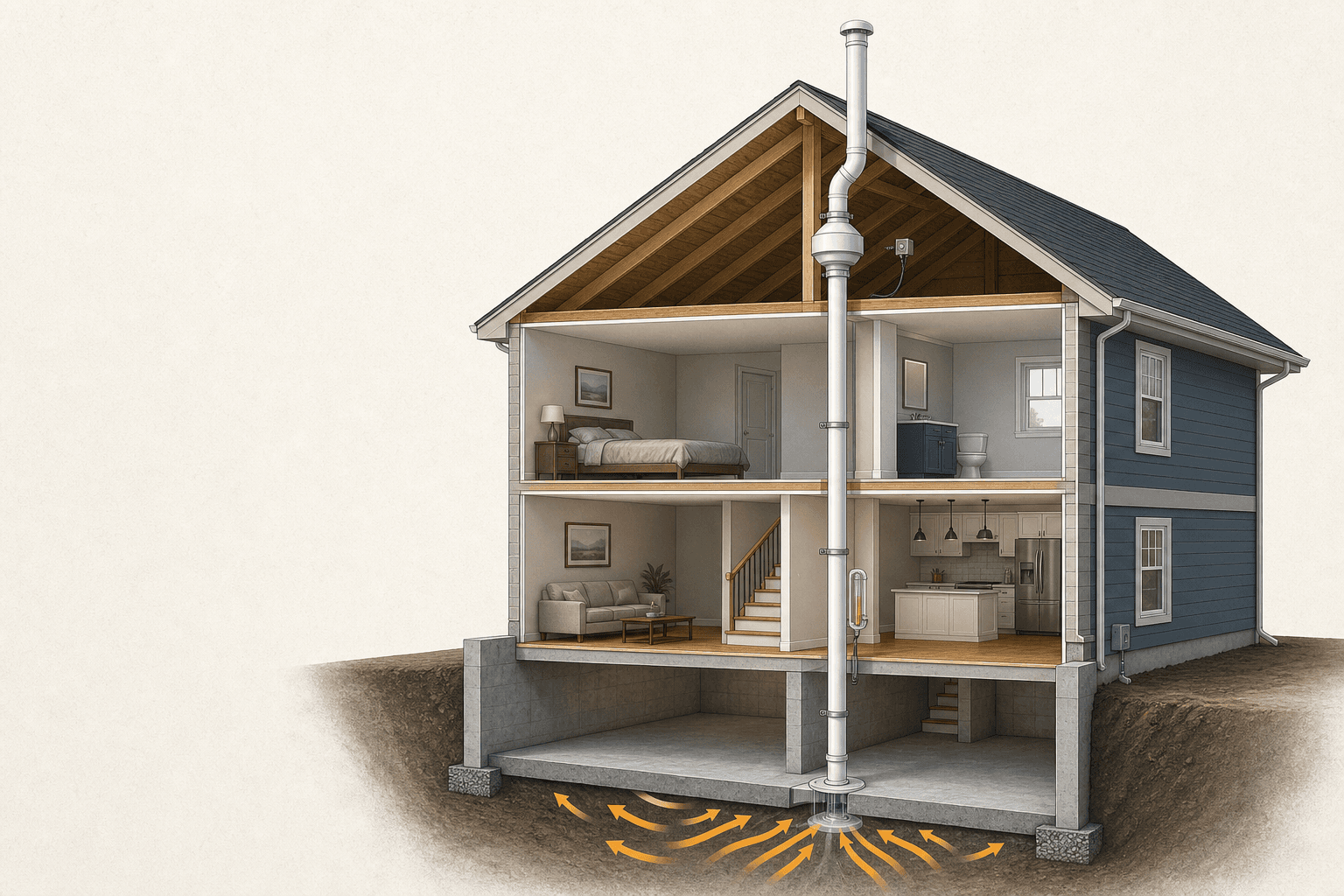
Illustration for explanation only. It is not a photograph of our work.
Start with the precise credential
Measurement and mitigation are different professional functions. Ask for the name of the individual performing each one, the credentialing organization, credential type, identification number, and expiration date. Verify that information in the current directory.
Do not accept a logo, company-level marketing statement, or old certificate as the final check. The person’s active credential should match the work they will perform.
Interactive checklist
Provider verification checklist
Mark each item as you gather it. Your selections stay in this browser tab and are never submitted.
0 of 12 complete
Understand what Montana DEQ does not certify
Montana DEQ states that its provider lists are offered as a convenience and that DEQ does not certify or require proof of certification for the contractors listed. DEQ also says listed individuals are certified through NRPP or NRSB and advises consumers to contact providers about qualifications.
Use careful language: a person may be listed by DEQ, credentialed by NRPP, or certified by NRSB. Do not combine those separate facts into a claim that Montana DEQ issued the certification.
Verify the business that signs the contract
The credentialed individual and contracting business may not be the same name. Confirm the legal business identity, public phone, contract signer, insurance certificate, workers who will enter the property, and who handles electrical work or subcontractors.
Ask the insurance agent or carrier to confirm coverage when the project warrants it. Do not rely only on “licensed and insured” in website copy.
Ask design questions that reveal the scope
A useful provider can explain how the proposal accounts for each slab, crawlspace, sump, addition, and route. The explanation should be understandable without guaranteeing an unsupported outcome.
Ask what diagnostics inform suction-point count, how the fan and pipe are selected, where discharge will terminate, how noise and condensate are handled, who completes electrical work, and what documentation is supplied.
Compare written bids and references
Montana DEQ encourages homeowners to gather at least three written bids, verify insurance and references, and participate in the details. Compare similar scopes and speak with recent customers whose foundations or project constraints resemble yours.
Reviews can describe communication and workmanship, but they do not replace credential and insurance verification. Be cautious with perfect claims, pressure tactics, unqualified health statements, vague guarantees, and a price that omits testing or electrical responsibility.
Keep a complete project file
Retain the credential check, written proposal, approved changes, invoice, system description, labels, operating instructions, warranty, permits or electrical records, and pre- and post-mitigation test reports.
If the property is sold later, those records help the next owner understand what exists and support the known-test and mitigation documentation addressed by Montana law.